Noticing your boiler pressure dropping? If the pressure keeps falling, your heating may not work properly, or your boiler could even shut down. In this guide, we explain the most common causes of boiler pressure loss, what you can check safely, and when to call a Gas Safe engineer.
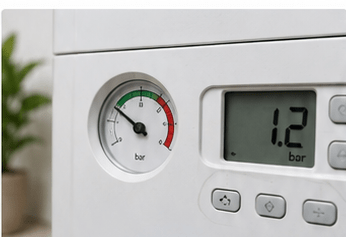
Your boiler uses water to heat your radiators and provide hot water. System pressure helps circulate that water through the boiler, pipes and radiators.
For many sealed heating systems, the pressure is normally around 1 to 1.5 bar when the system is cold, although the correct range depends on the boiler manufacturer and model.
If the pressure drops too low, your boiler may display a fault code, lock out or fail to heat your home properly.
If your boiler keeps losing pressure, there is usually an underlying reason. Some of the most common causes include:
Leaks in the heating system
Small leaks in pipework, radiators or joints can cause pressure to drop gradually over time.
Faulty pressure relief valve
If the pressure relief valve is leaking or failing to close correctly, water can escape from the system and reduce the pressure.
Automatic air vents leaking
Automatic air vents can occasionally leak small amounts of water, causing system pressure to fall.
Expansion vessel issues
If the expansion vessel is not working correctly, boiler pressure can rise and fall significantly as the heating system warms up and cools down.
Recent radiator bleeding
Bleeding radiators releases trapped air but can also lower system pressure. The system may need to be repressurised afterwards.
Internal boiler leak
Water escaping from an internal boiler component can also result in repeated pressure loss.
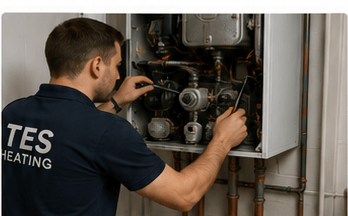
There are a few simple and safe checks you can carry out before calling a heating engineer.
Check the pressure gauge
Look at the boiler pressure when the system is cold. If it is significantly below the manufacturer’s recommended range, the system may need repressurising.
Look for visible leaks
Check underneath radiators, around radiator valves, exposed pipe joints and underneath the boiler for water or dampness.
Check the external discharge pipe
If water is repeatedly dripping from the boiler’s pressure relief discharge pipe outside the property, the system may need professional attention.
Look around radiator valves
Small leaks around valves and connections may leave damp patches, staining, corrosion or mineral deposits.
Important: If you cannot see any leaks but the boiler pressure keeps dropping, there may be a hidden leak or an internal boiler fault. The system should be inspected professionally.
If your boiler pressure is too low, many modern boilers allow the pressure to be restored using a filling loop or built-in filling mechanism.
The exact procedure varies between boiler manufacturers and models, so always follow the instructions provided with your boiler.
On systems that use a traditional filling loop, the general process usually involves:
Note: If the boiler pressure drops again soon after repressurising, repeatedly topping it up is not a permanent solution. There is likely an underlying problem that needs investigating.
You should arrange professional assistance if:
Safety First: Work involving internal gas boiler components should be carried out by an appropriately qualified Gas Safe registered engineer.
Regular maintenance can help identify small problems before they develop into larger heating faults.
Have your boiler serviced regularly, keep an eye on the pressure gauge and occasionally inspect visible radiator valves and pipework for signs of leaks.
If you bleed your radiators, check the boiler pressure afterwards and restore it to the manufacturer’s recommended level if necessary.
Repeated pressure loss can be caused by a small leak somewhere in the heating system, leaking radiator valves, a pressure relief valve problem, expansion vessel issues or an internal boiler fault.
Many sealed heating systems operate at approximately 1 to 1.5 bar when cold, but the correct pressure varies between boilers. Always check the manufacturer’s instructions for your specific model.
Occasional repressurisation may be necessary after bleeding radiators or carrying out heating work. However, if you need to top up the boiler regularly, the cause of the pressure loss should be investigated.
The cost depends on the cause. A leaking radiator connection may require a relatively simple repair, while an expansion vessel or internal boiler fault may involve additional parts and labour. An inspection is usually needed before an accurate price can be given.
Regular servicing, checking for visible leaks, monitoring the pressure gauge and dealing with small heating system problems early can help prevent recurring pressure issues.